
A terrible place to loose a cow.
Wednesday, August 3, 2016
Friday, July 29, 2016
The over winter greenhouse
 |
| I use a gas heater with a thermostat set to 54 degrees for tropicals. This is to save plants from freezing only, the 2 coldest months of the year, and to extend the growing season 6 to 8 weeks of the year. Without artificial heat, a hoop house of this size will only extend the growing season by 4 weeks, or one zone. So some of the elephant ears in this image would go dormant in January... When its 25 degrees out for 10 hrs. it gets into the high 30s inside just before dawn for 1 or 2 hours, so the most tender of plants, in the coldest 1 or 2 months, will go into dormancy. I have found over the years that some bulbs do not survive these short periods of cold then warm, but rot, and would fare better in the ground outside covered with mulch. However this is a plant collectors green house. Hardiness, moisture requirements, mature size, disease and pest restance, behavior, shade sun tolerance are unknown, as many of the plants have only recently been discovered in far away lands by plant hunters, spent a period in the USDA quarentine station, then sent to tissue culture labs or propagated for plant collectors like me who grow them in different environments to find where they fare best. 25 to 30 percent are finicky and hard to grow, 60 percent are worth having beside something prettier, but about 5 in 100 are wondrous, and make the horticultural industry. |
 |
| These palms are too close together. |
Even an expensive professional greenhouses can't take the high winds that they will sooner or later be exposed to. A location sheltered from the prevailing winds, storms, and northern fronts will keep you from worring in gusts of wind . If there is nothing like this around, you could plant them. A large clumping type subtropical bamboo did much to save my house during 12 hours of 140 mph winds in Hurricane Rita in 2005 (bambusa textillis). It comes in a large and smaller form. It is hardy to 15° F when it gets frost bitten. Here in zone 8b it froze to the ground 30 years ago @ 8° F, and recovered in about 3 years as pretty as ever. If you don't have much room you should try something smaller. Southern live oak, bald cypress, and clumping bamboos made up the bulk of what was left when the wind subsided after Rita.
Make sure the location has good drainage. Water from rains and watering plants should drain away sufficiently well. Imported sandy soil is usually necessary to some degree. During the rainy season would be the time to check drainage before you build anything.
 |
| Half as much magnification would be better. |
Growing is a joy if your setup is done properly, but if it isn't you will be more likely to fail and become discouraged before you start.
 |
| USGS The old people know. |
Though only little bugs, small infestation of white flies, mites, or aphids can become almost as bad as the cold temps outside. Get yourself a pocket microscope ($10 on line). The one depicted here magnifies too much, so try one with less magnification. Go online and study spot, fungus, aphids, white flies, and mites. Spot or fungus will be a problem in greenhouses that stay too damp. Keep your plants 18'' off the ground or floor for plants subject to spot such as palms. Spot and fungus live on the ground and contact plants when a drop of water hits the ground and splashes the tiniest particle of moisture on them. Even condensed moisture dripping from the poly top starts infestations when it drips to the floor and splashes on the plants. Then when your moving plants around, one that has spot touches the other and bingo.
Your watering wand spreads spot from one plant to the other while watering. Most tropical plants eat spot and fungus for breakfast so don't worry about spot on them so much, only the pests.
 |
| Pointed slightly downward. |
On warm days open your house up and let the natural breeze through. Sometimes when it's cold out, the best way to control the pest is to drop the temperature inside the greenhouse and spray everything in it with a soap (fatty acid only, Palmolive green dish detergent) and water mixture. If a plant is infested really bad with pests, put there butt outside in 33 degrees.
You can burn more sensitive plants with soap, so mix properly. This is your best weapon against these pests. You can spend 30 years trying every thing else, but you will come back to it. Spray bottom of leaves first, and then top until run off. Good luck


Friday, July 22, 2016
Wheat field in the Clouds, Andes Mountains

With a greater understanding of it, the depth of beauty increases. What good is a mountain in the darkness.
Tuesday, July 12, 2016
Nelumbo nucifera, The President lotus
 |
| 4th day flower. |
Lotus are an invasive, or you might say successful aquatic plant. Don't plant them in an earthen bottom pond unless you want a pond full of lotus. I've had them in my pond rooted in 8' of water, and from that point the runners can spread another 15 feet on the surface, literally covering the surface of a large pond in 5 or 7 years. This can be depressing if you want to fish. However, you will not be sad at bloom time. A field of blooming lotus commands the attention of Kings. As glorious a sight as any mountain range they are. Yes Sir.
 |
| 2nd day flower. |
This is what happened in my pond some years ago when I planted azaleas all around it and fertilized them regularly. The run off from the sprinkler system drained in the pond. As soon as the azaleas took root and started growing on there own, I quit fertilizing them and the lotus are now 99% gone. These first lotus were the native American lotus ( Nelumbo lutea ), nucifera species, and Mrs. Perry D Slocum, quite a sight in summer. I've never had The President before this year (Pond Mega-store $40 )... It's a bit more red than other reds and the species plant. It's in a 30 gallon tub now with 6'' of topsoil and water. The open flower is 11 inches wide.
https://en.wikipedia.org/wiki/Nelumbo
Friday, July 8, 2016
Kingdom of Heaven

Mathew 13:44 NIV
Wheat fields here at an elevation of 12,000' and higher, are sometimes in the clouds.
Image of farm fields in the Andes Mountains near Salinas de Maras, Peru.
https://en.wikipedia.org/wiki/Parable_of_the_Hidden_Treasure
Wednesday, June 29, 2016
Ice Cream Banana, Musa Blue Java

However last winter was not cold enough to kill the plants and for some reason they bloomed early. The bananas in this image should have time to ripen before the cool weather gets here, so I fertilized them, which helps development. They are supposed to have the flavor of vanilla ice cream. The plants are about 15 foot tall. Average trunk diameter is 12 inches.
Bananas are easy to grow providing they get lots of water, they like being watered from the top, as if it were rain. It cools the tree from warm temperatures that occur at the hottest part of the day, which is when thunderstorms occur in the natural environment, and the plant drinks from where water collects in natural pockets formed, where the leaves meet the pseudostem, as well as the roots. They love rainy weather and the past couple years here have been abnormally wet. I don't usually fertilize them unless there is a chance I get fruit. This summer there are more flowers in my Banana groves than I've ever seen.
 The banana tree is not a tree at all, but a herbaceous plant, a herb, or a berry.There is no woody substance in the trunk (pseudostem). However bananas are fruit.
One surprising thing about banana trees I've experienced is that once a banana tree has achieved its mature form, it does fine in temperatures to cool for it to have matured in the first place. It will do well, and seems to like temps around 60F.
October 14,16 my banana bunches are ripening beautifully. This is a very sweet, fruity, slightly tart, tasty banana.


https://en.wikipedia.org/wiki/Blue_Java_banana
Wednesday, June 22, 2016
Musa laterita, Bronze Banana
 Musa laterita is one fine ornamental banana. Native to Indochina, it's only grown in the U.S. by a few collectors, and not very well known to the trade, garden centers, or the average gardener. It is an inedible, joyous celebration of a plant and it's not da kine to get rid a bra, as the Hawaiians might say.
It behaves just like a typical banana, it wakes up late March here in the South, and begins growing like a banana should 1st of May.
Bananas hate wind, it can make them ragedy, they're just not made sturdy enough, but can rebound from a storm quickly. They love heat to 90F but get droopy at 95F and any hotter they will look plum sickly. Banana trees love rain, three times a day, every day is what they like, with good drainage of cource. They are imune to fungus, spot, and pest free here. They love grass clippings or anything organic from last year around the base. Old bales of hay work wonderfully, the older the better, and especially during droughts.
 |
| 8' high 10 ' wide grove started 2 years ago with 3 small plants. |
The best thing you can do for your plant is improve the ground around it. So learn of its sand, clay content, porosity, and PH. This will eventually lead you to understand that the plant benefits greatly from the grass clippings around it, so improve the health of your grass, and throw it towards your plant with the lawn mower. I am a long time plant collector, and every plant I have in the ground, loves the flavor of grass clippings.
 All green things speak the same language, unlike the man who spends most of his life learning the most basic terminology. The problem is, he thinks too often he is the teacher, but in fact the student to a source all knowing. So pay attention to this fact early in your life, and you will learn all important and beautifully far ranging truths.
If you fertilize bananas with cheap triple 13 fertilizer, they will make you smile brother, but they are not picky, they do just fine with little attention in the Southeast, where it should be against the law not to have a banana tree by your porch, so when it rains, it can summon the beauty of its home in the moan-tane rainforest. If you walk through the rain forest, in the rain cousin, you will understand.
 Musa laterita will flower it's heart out for you. As soon as it achieves its full height in May, it will bloom till the temps dip below 55F in the fall, then it will get sleepy until the frost kills it to the ground, at which point, the corm rests the winter to do it all over again next spring, here in South Louisiana, zone 8b... Imagine a good and faithful soldier.
https://en.wikipedia.org/wiki/Musa_laterita
Wednesday, June 15, 2016
Megalithic Stone work at Ollantaytambo, Peru
 |
| Megalithic Period stone work. |
South America is a treasure chest of ancient ruins, the most awesome of which are accessible only by days of hiking, usually in remote high areas, and have never been cleared of forest or excavated, some estimated older than the Pyramids of Giza. If this is true, then life possibly began here instead of Africa.
The Sacred Valley of Peru is made of the highest convictions. The construction practices used, the artistic manipulation of stone ( stone masonry) the cutting/ fitting of dense material to such close tolerances as depicted, the transport of items to 300 tons from a distant mountain and across a valley are puzzling even by the standards of 21st century machinery and engineering. The oldest stone work here in The Archaelogical Park at Ollantaytambo is considered among the best in Peru.
As a whole, we don't understand how they did it, or what became of this discipline as it appears to have vanished long before the appearance of the Inca.
 |
| View from the top of the Fortress/Temple |
We as simple creatures have been taught that evolution along with the education process of this so called modern day will produce a more complete society, where in fact it is exactly possible that the contrary, amongst other unimaginable scenarios is true, and according to the ages, time in its vastness sees what men might ever think irrelevant. The intelligence of mankind is being limited by a shortsighted misconception, that there is no need for it, and possibly has been this way for millennia.
 |
| From the Temple/Fortress across The Sacred Valley to Pinkuylluna and Grainary Ruin |
The question allows convictions of the highest order, a freedom for each individual to create in himself, the scope of his being. The evidence here insists that if one wishes and works real hard at it, he may advance himself far above the understanding of a vast majority who can/will not read the inscription in every particle, the universally glyphic language of images. The understanding to the grave complications of humanity is contingent upon the ability to decifer from a far greater source of information, available only in a language of images. This is the best medium to deliver/translate information.
But to understand from what one sees, then decide upon an action to take is a responsibility a complacent population does not want to assume. It is a matter of choice to be so devout/deciplined. Only few will undertake such an enormous/incompatable endeavor. The far greater majority want to be comfortably led.
This is exactly where a population becomes separated into 2 groups. One who believes it is detrimental, and the other understands with good reason it is imperative.
At this point, these two groups of people loose the ability to communicate, one does not see the other as living in the same time. The other believes the one to be extinct. One struggles to speak, while the other only hears the wind.
Group #2 operates as a whole, their ideas are based on the human condition, worldly goods. What is valued most important to them is appearances and the self. Their numbers constitute the visible population of humanity.
Group #1 operates, each as an individual. Their ideas are based on every demention of the absolute. What is valued most important to them is the beauty of the truth, mans role in its appreciation. Their numbers are scant.
Group #1 built the lower levels of these sites.
https://en.wikipedia.org/wiki/Ollantaytambo
Saturday, June 11, 2016
Ollantaytambo, Sacred Valley, Peru
 Street in the old town near hotels/hostals/beds and breakfasts within walking distance of the most fascinating ruins the most high minded of men could imagine.
This place is Uplifting Cousin, and I want you to go. So get off it and online to see just how affordable Peru travel is. Gas is about $1 US per gallon here, so guess what, taxis and buses are cheap. WiFi is decent and almost always free at hostels and hotels although service is sometimes spotty or disrupted in smaller towns. You may have to go across the room or street and try again. Check with your hotel for taxi prices. Hotels and taxis are all connected and on the same page with prices for fares and tours. Generally, a taxi for all day is S/.220 or about USD $72. Taxi from Cusco to Urubamba or Ollantaytambo is S/.170 or about USD $45 to $55. Collectivos are much less. Buses are dirt cheap if you have time. An English speaking cab driver will cost a little extra. Spanish is the #2 language in the world and will be, so learn the basics. A tour guide will also be extra. So read up and know what you are going to see before you get there.
 |
| Terraces at Pumatallis. |
The language barrier is really no problem, just negotiate where you want to go, which takes few words, smile, pat the driver on the back, say I buy lunch, OK? And its on cousin. This simple offering suggests that you take care of the people around you, and instills confidence in strangers you need to help you. Keep your word, and be good to them, this allows for their judgment to give you the benefit of the doubt, and they will take you to that special place no one else gets to see. They will work hard for you.
 |
| Ruins atop Pumatallis, terraces at Ollantaytambo overlook Sacred Valley. |
Watch the videos on YouTube. Buy a couple books on the Sacred Valley and Cusco on line. There are so many to choose from. No I don't get paid for this. When you get back you will understand fully. I just don't want you to miss U. flight 854 IAH Depart Houston 4:50pm nonstop approx. 6.5 hrs Arrive Lima 10:54.
 |
| Brugmansia (Angels Trumpet) grows wild here. |
We stayed at Ollay 3 days. Its owners were two young people, with a little boy getting started in the hotel/taxi/tour business. The hotel manager was an eager to help people person from Belgium, he spoke fluent English, French, Spanish for sure and people from Belgium often speak German, the language of their eastern neighbors and probably family, but I did not hear it spoken. But this is not typical.
Tourism is big in Peru and its people are excellent in the hotel restaurant trade. Did I say the food is outstanding, fresh, beautifully prepared. The alpaca, Llama meat isn't wild tasting but much like beef. Roasted chicken is is where I started while I did a lot of tasting of so many vegetables I had never seen before. Peruvian food is far more healthy than American food and a late lunch is the big meal of the day at which time everything stops brother, everything. Check with you doctor to see if you can eat the unpeeled uncooked fruits and vegetables. The small, yellow, bruised up, pointed, bananas are better than any banana I've ever tasted here in the U.S.
 Hotels can arrange any kind of tour, get you a car taxi, motorbike taxi in 5 minutes, know where everything is in town and The Sacred Valley, and for some reason have the most soft spoken, patient and polite receptionists, real Ladies and Gentleman. I am practicing this. It would be a good place to send American children to school to learn some respect from the Peruvian children.
Ronaldo, our driver took us down every beautiful road in the Sacred Valley. I had no idea the countryside in the high country near Maras was so beautiful, especially the rolling hills within sight of glaciers in the high Andes, and patchwork different colored farm fields and sprawling golden wheat fields that touch the clouds. Holy Smoke man, I would have gone much, much farther to see that alone.
 |
| Typical street in old town, ancient ruins upper left. |
Our hostal in Ollay had just outside the window a rocky, mountain fed stream, a towering mountain, and a cornfield with a farmer tending his cows and burrows in the old manner. These people treated us really good. They were more than reasonable, and we felt safe with them. The little boy likes Hershey bars and M&Ms, Could you bring some extra?
https://en.wikipedia.org/wiki/Ollantaytambo
https://en.wikipedia.org/wiki/Sacred_Valley
Thursday, June 9, 2016
Growing Sweet Corn
 |
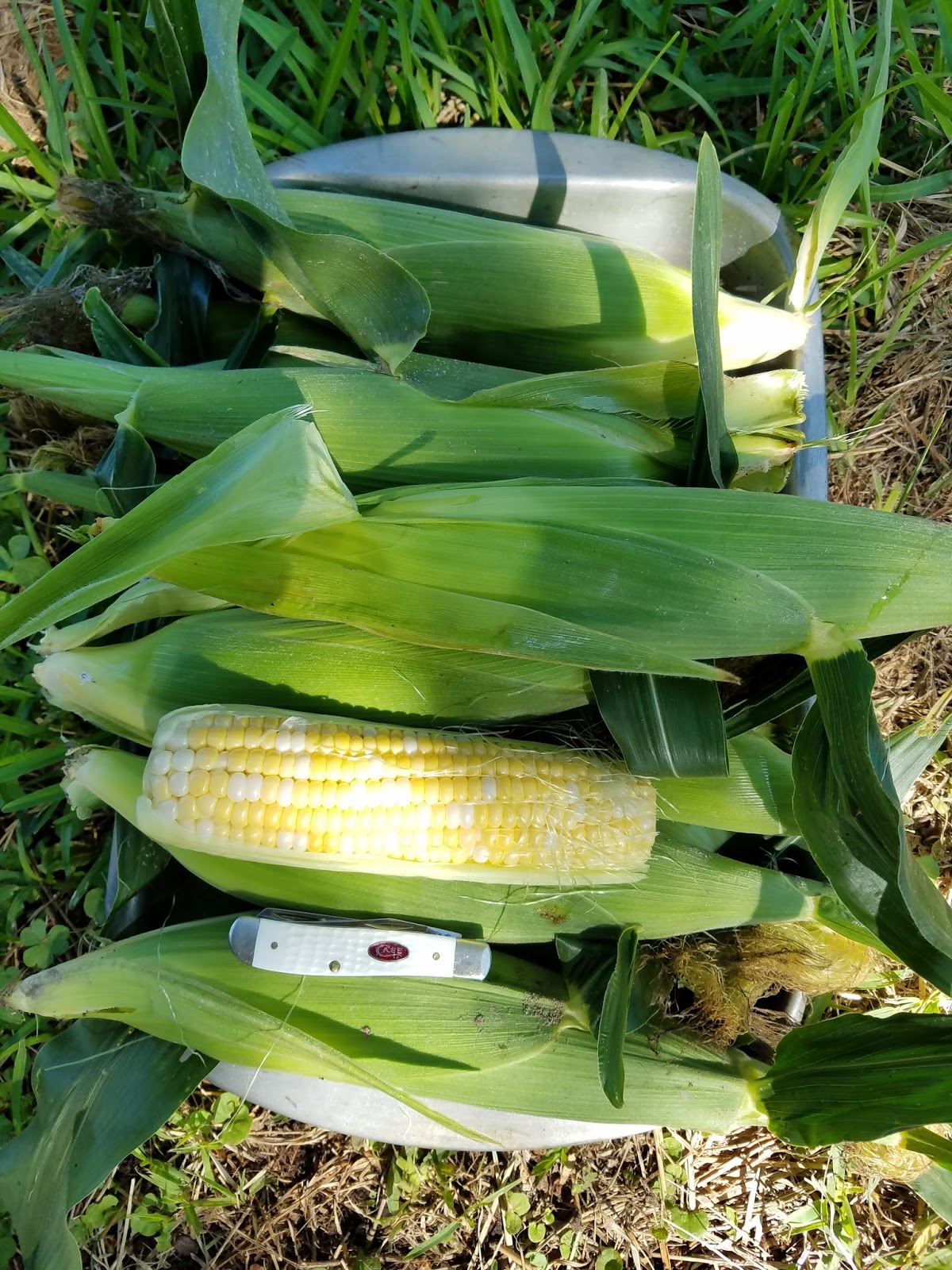
| The pan is 9 inches wide. |
When the seed arrived it looked desiccated beyond what corn seed should look like. So I figured I might have gotten bad seed.
Late winter here in zone 8b was warm enough for the grass to be green in my garden, and far too wet to prepare rows which we must use in South Louisiana to keep the seed from sitting in water in our flat terrain.
 |
| If planting 2 different types corn, you must have them at least 1000' apart to realize a crop true to name, to prevent cross pollination. |
 |
| Plant a seed young man. |
I sprayed the new silk for worms and worms gave me no trouble. It did very well growing in mud. It made a pretty good number of ears. It is by far the tenderest corn I have ever eaten, and the sweetest. Ears are a little small (6 to 7 inches, the pan is 9 inches wide) but extremely uniform and easier to handle, and chomp on when eating fresh boiled. I think this is good, despite the fact I wanted big ears. Huh! I have changed my mind again.
There are many good types of sweet corn to plant, but I will probably plant this again next season, as I am very happy with its performing so well under adverse conditions. This fact is uncommon. Good Luck.
Sunday, June 5, 2016
Terraces Above Urubamba River, Sacred Valley Peru
 |
| You must enlarge to appreciate. |
Ancient farm terraces lie idle 3000 foot above the Urubamba River. Swords of first light reveal, a garden in the sky.
This is one of the most difficult places in the world to get to if you figure the number of flights, cabs, trains, buses, tickets, bribes, but it was every bit a blessing. I had about 4 seconds to make this image as the sun came over this sharp moan-tane so quickly. Five seconds would not reveal the swords any longer. I took one at about 2.5 seconds and one at 4 seconds and it was gone. This is the one at 2.5 seconds. The other is slightly lighter. Both are in good focus and definition. This is the 5 seconds of magic I've been telling you about cousin, and it will carry you over.
This will be the first of many images I made throughout the Magnificent Country of Peru, and The Andes Mountain Range, where from I learned the correct pronunciation of the word " Moan-tane " by a spiritual Peruvian. I believe He's right.
From Lima south to Arequipa across the High Desert/Vicuna -Lama- Alpaca Reserve wilderness ( 8,000' to 16,800' ) and the breathless volcano region, to and along the Colca Canyon from Chivay. The many Inca and Pre Inca Megalithic stone masonry/ruins of the Sacred Valley and Cusco. Points of interests, Churches, Cathedrals, Convents, Monasterys, Holy Places, pottery, jewelry, art of all sorts, Peruvian Market, farms, indigenous peoples and culture.

My favorite medium has always been film, color negative or slide. This is the absolute reason I have shown you so few of the images I have made in so many wonderful places. Because I have a hundred good negatives for every image I've shown you, but they have never been scanned and converted to digital which must happen to get them online into google images. Yes I did use my $99 printer scanner to do those fuzzy ones. I've been so busy working for so long, but I quit all that. I'm going to buy a good scanner soon and haul out the shoe boxes of negatives.
On this last trip the rewind mechanism broke on my favorite film camera on the first day in Lima on the third roll of 120 slides. Good news is every frame I took after that point is available now. I did it all in digital on a new camera I had just bought in case. I shot 10 times what I would on film. Sure I got a heap of junk, but I am finding out there probably is 4000 images on the disks, and some are kik ass. I made more good images on this trip than I would have with film, but the best are usually film.
If I can figure out how to get the digital definition on line as it is on camera and monitor. Terraces above Urubamba image definition is far better than the windows 10 version you see. Will republish better later.
https://en.wikipedia.org/wiki/Sacred_Valley
Thursday, May 19, 2016
Kilauea, Gifts to Pele
 |
Place where native people come to honor the Goddess of the Fire. |
will always be true, in this new day adorned with wonder_ there is entwined, reputable information that would greatly alter the firm conclusions you have made_ because you are only a man.
So be humble, and thankful.
Kilauea volcanic vent, Volcanoes National Park, Big Island Hi. The Southernmost and largest of the Hawaiian Islands. The southernmost point in the U.S.
https://en.wikipedia.org/wiki/Hawai%CA%BBi_Volcanoes_National_Park
Friday, April 29, 2016
Louisiana Irish Potatoes
 | |
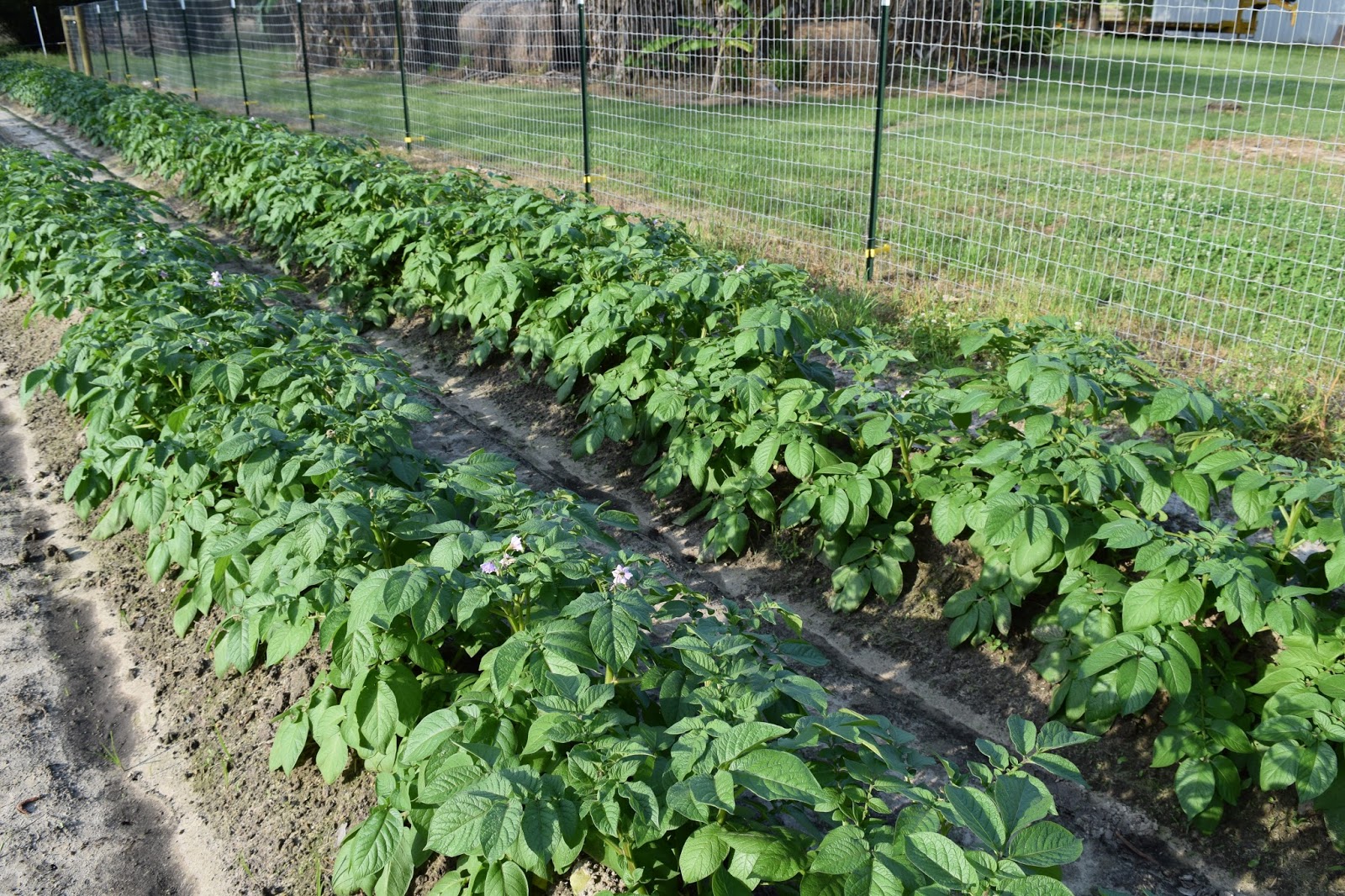
| Seed potatoes only from feed store or last spring. Plant February 15. |
 |
| Very well drained sandy soil 8'' apart. A little fertilizer now more later when hilling dirt around plants when 10" tall. |
 |
| Middlebuster |
 |
| It helps to remove greenery before plowing. |
 |
| So_ when the furrow is empty, you will remember when it was full. |
Subscribe to:
Posts (Atom)